
Calla knows how the lottery works. Everyone does. On the day of your first bleed, you report to the station to learn what kind of woman you will be. A white ticket grants you marriage and children. A blue ticket grants you a career and freedom. You are relieved of the terrible burden of choice. And once you’ve taken your ticket, there is no going back. But what if the life you’re given is the wrong one?
When Calla, a blue-ticket woman, begins to question her fate, she must go on the run. Pregnant and desperate, Calla must contend with whether or not the lottery knows her better than she knows herself—and what that might mean for her child. With Blue Ticket, Sophie Mackintosh has created another mesmerizing, refracted vision of our world that explores the impossible decisions women have to make when society restricts their choices.
Rating (out of 5 stars): 3.5/5
Imagine a world where your future is determined by a lottery.
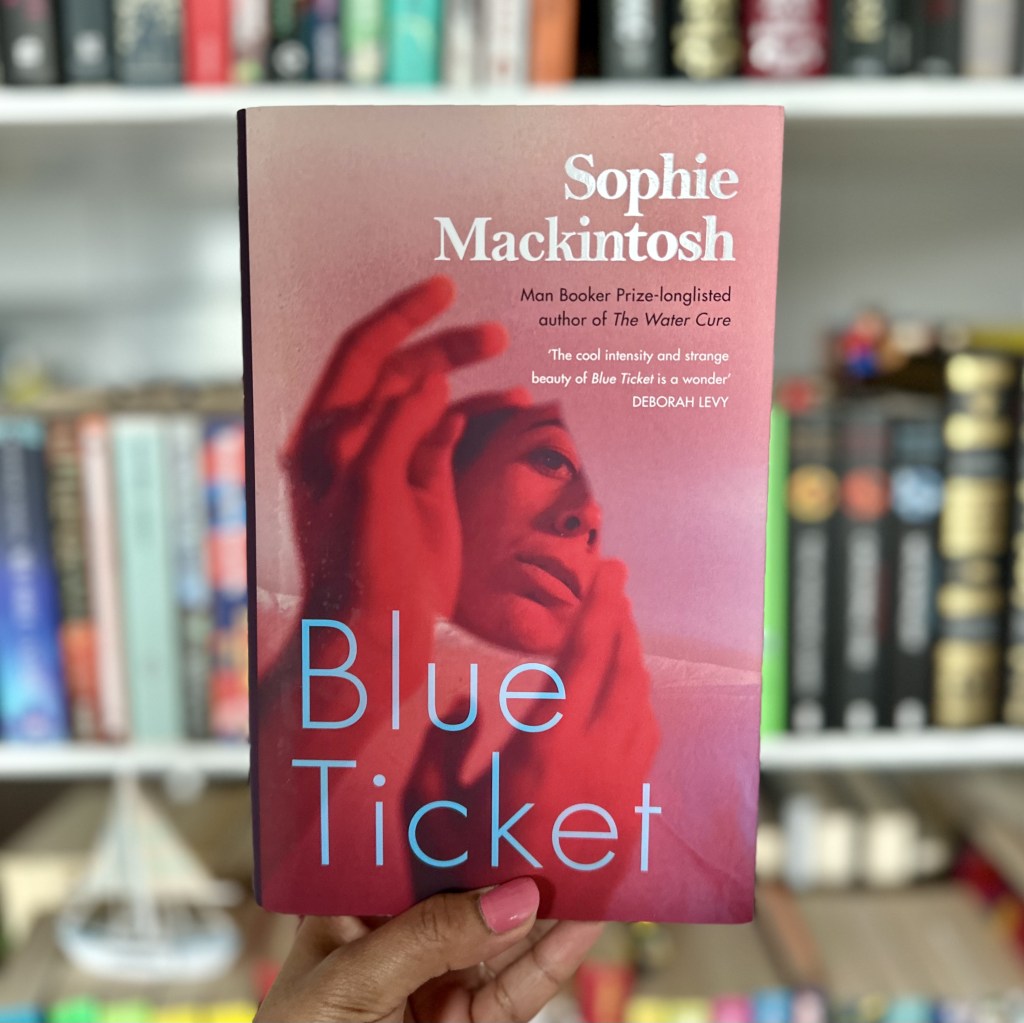
That is the world of Sophie Mackintosh’s novel, Blue Ticket.
In her follow up to Booker-longlisted The Water Cure, Mackintosh presents a dystopian world where a lottery system provides girls with a ticket on their first period, which in turn determines their fate.
A blue ticket grants you freedom.
A white ticket compels you to bear children.
Calla, the protagonist, is relieved at having been stripped of the choice of motherhood.
Unlike The Handmaid’s Tale, the victims of Blue Ticket are the sexually liberated women. Yet these women are also under patriarchal domination. With a lottery deciding their fates and state doctors doing routine check-ups, Calla is a character who feels like she does not truly know herself.
As a blue-ticket woman, Calla is free to work, drink, smoke, and sleep with whomever she pleases. At one point she describes blue-ticket women as having been given the “independence, of pleasure seeking and fulfilment.” Yet, she finds herself unhappy with the path chosen for her. A “dark feeling” grows in her; a yearning to have a child.
We follow Calla’s journey, where she will risk everything to have a child, from painfully removing the contraceptive device with a pair of tweezers to becoming a fugitive.
On her journey she encounters other pregnant blue-ticket women, and even a white ticket woman, who wants nothing to do with motherhood.
Mackintosh explores a range of dichotomies in her novel. The Madonna-Whore complex is evident in the characterisation of the women in her novel, where the white-ticket women are revered and protected, and the blue-ticket women are characterised as promiscuous. While the narrative voice is shaped by the patriarchal system she was brought up in, as a young woman myself who does not want children, I was uncomfortable by the depictions of childless women.
There is also the dichotomy of nature versus nurture and free will versus societal control. Is maternal instinct an inherent thing that all women have? I couldn’t help but wonder if Calla’s strong desire for a child, simply arose because it was denied to her.
Despite the attempt to tackle important themes, Mackintosh often sacrifices other story telling aspects for thematic exploration, which leaves me with conflicted feelings towards the book overall. There is a frustrating lack of world building, which lowers the plot’s stakes. I was left asking, why is the world like this? Why has the lottery been set up? Why aren’t the men subject to this authoritarian control? While I could see the parallels being drawn to the real world, I was left with far too many unanswered questions about the fictional world.
 Train of Thought
Leave a comment